

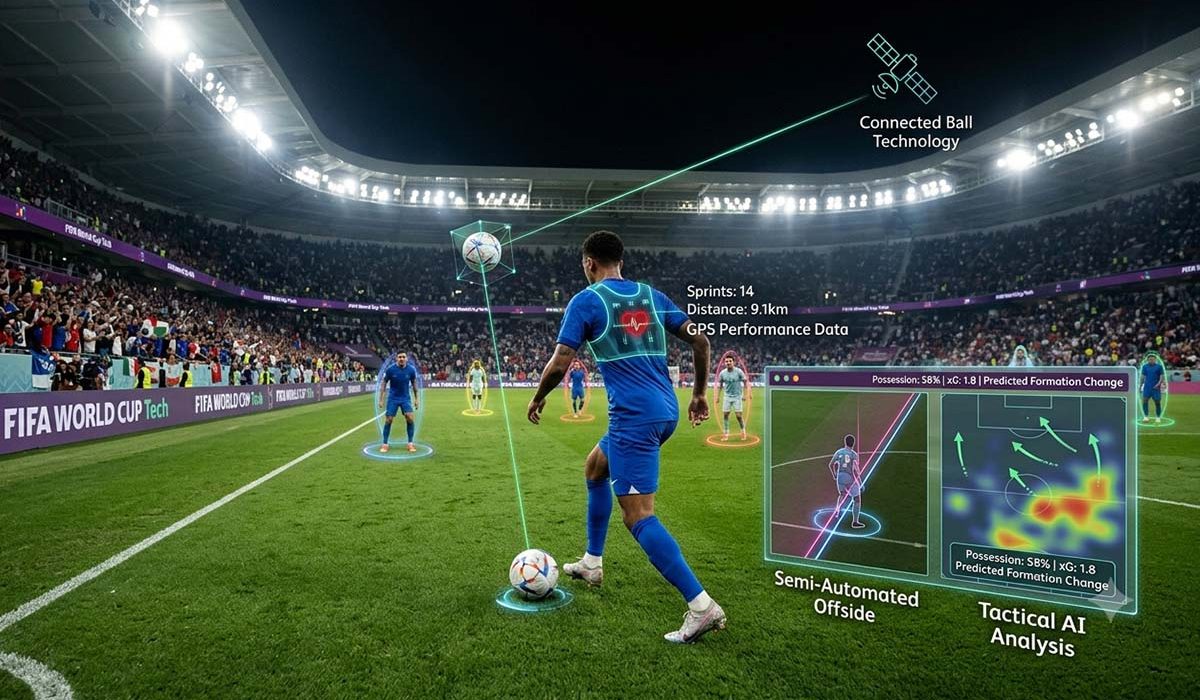
The FIFA World Cup has always been a tournament of raw human emotion: the roar of a stadium, the gut instinct of a manager, and the split-second brilliance of an elite striker. But if you look closely at the pitches across the United States, Mexico, and Canada, you are looking at a highly synchronized digital ecosystem.
With 48 teams competing at the tournament, technology is no longer just an optional assistant; it is fundamentally rewriting how football is played, managed, and broadcasted.
1. Connected Ball Tech & The Smart ‘Trionda’
At the center of every play is the Adidas Trionda, the official match ball of the tournament. Far from a simple leather sphere, it is an advanced piece of sports engineering:
-
The Core Sensor: The ball houses a state-of-the-art Inertial Measurement Unit (IMU) sensor chip suspended at its center.
-
Granular Tracking: This sensor captures data 500 times per second, tracking the ball’s absolute acceleration and three-dimensional orientation in space.
-
Instant Impact Mapping: The moment a boot makes contact with the ball, data is instantly beamed to the Video Assistant Referee (VAR) room, pinpointing the exact microsecond of a pass or shot.
2. Artificial Intelligence and 3D Player Avatars
Offside controversies are becoming a thing of the past thanks to Next-Gen Semi-Automated Offside Technology (SAOT).
Before stepping onto the pitch, every participating player undergoes a rapid one-second 3D digital scan to capture exact body-part dimensions. During a match, 16 roof-mounted optical tracking cameras generate over 150 million tracking data points per game, mapping 29 points on each player’s body 50 times per second.
When a potentially offside pass is made, an AI instantly cross-references the Trionda ball data with the players’ exact digital avatars. For the first time, automated positional offside alerts are sent directly to the match officials on the pitch, cutting down decision times drastically. Furthermore, these lifelike 3D player models are instantly rendered into TV broadcasts, making offside calls immediately clear to millions of fans watching at home.
3. Leveling the Field: Football AI Pro
Tactical analysis used to be a luxury reserved for the world’s wealthiest footballing federations, who could afford massive teams of data analysts to comb through 60-page post-match reports.
To bridge this digital divide, FIFA and Lenovo launched Football AI Pro for the tournament. This generative AI knowledge assistant is provided equally to all 48 participating nations. Coaches and analysts can simply type natural language queries to instantly extract tactical insights, break down opponent defensive blocks, and review 3D match recreations. Whether you are a traditional powerhouse or an underdog making a historic debut, elite data analytics have officially been democratized.
4. Enhanced Broadcasts: The AI Referee View
For the fans watching globally, broadcast innovation has evolved past simple ultra-slow-motion. The tournament features an upgraded version of Referee View. Cameras attached directly to the referee’s kit utilize real-time AI stabilization software to completely smooth out motion blur caused by sprinting or sudden movements.
The result is a highly stable, pristine first-person perspective. When a high-intensity argument breaks out or a penalty is awarded, audiences get to experience the drama exactly from the official’s eye-line, bringing fans closer to the grass than ever before.